
Every emerging market has a week when the debate quietly ends. Not because someone wins the argument, but because the evidence stops arriving one data point at a time and starts arriving from every direction simultaneously. For agentic commerce, that was last week.
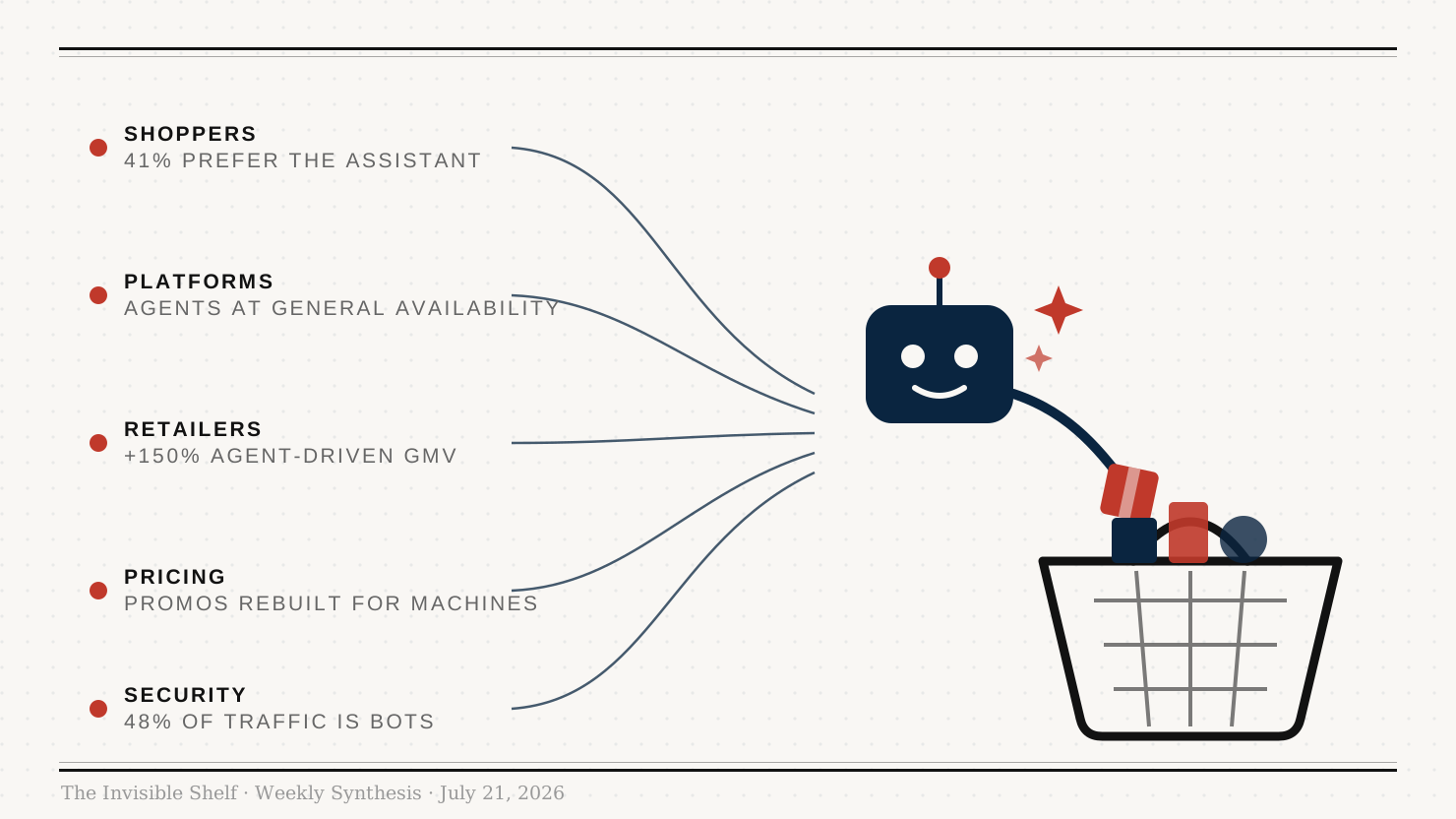
Five stories landed in seven days. Individually, each is a solid trade headline. Together, they describe a market where the demand side, the supply side, the economics, and the threat model all matured in the same news cycle. If you run a CPG brand, here's what actually happened, and what it means.
The Demand Side: Consumers Have Already Switched
Start with the shopper. Bloomreach surveyed more than 4,000 US and UK consumers and found that 75% have used ChatGPT, Gemini, or Claude to help them shop in the past six months. Not tried once — 42% use AI shopping tools daily, and nearly 70% use them at least weekly.
The number that should reorganize your Monday meeting: 41% of consumers would now rather shop through an AI assistant than visit a brand's website directly. That's more than the 38% who still prefer the brand site. For the first time, the assistant beat the owned channel in a head-to-head preference question.
And this isn't reluctant adoption. Eight in ten say AI shopping results met or exceeded expectations, 61% say AI increases their confidence in purchase decisions, and 56% plan to use it more over the next twelve months. The customer relationship is forming inside the assistant. Your website is becoming the warehouse behind the storefront.
The Supply Side: The Infrastructure Shipped
Demand without infrastructure is a survey result. Last week the infrastructure showed up too. Salesforce made its Agentforce Commerce agents — Shopper, Buyer, and Merchant — generally available, with native ChatGPT integration live and Google Search AI Mode and Gemini arriving this summer. This puts agent-led selling within reach of the mid-market, not just the giants. Salesforce's own data frames the stakes: AI influenced 20% of global online holiday sales, roughly $262 billion, and retailers running their own shopper agents grew sales 59% faster than those on the sidelines.
Then there's the giant. Walmart's numbers on Sparky, its AI shopping agent, are the most concrete agentic commerce results any retailer has published. Sparky-attributed value of goods sold grew 150% in Q1. Sparky users build baskets 35% larger than non-users. Units sold through Sparky are up 4x year over year — driven not by gadget hunters but by consumables replenishment and meal planning. Half of all Walmart app users have interacted with it.
"If Sparky is on autopilot, then it will automatically restock the pantry and fridge. This is not theoretical; it's actually happening."
— Daniel Danker, EVP of AI Acceleration, Product and Design, Walmart
Read that quote again as a CPG brand. Automatic pantry restocking means the agent decides which ketchup goes in the basket every time, without a human glancing at the shelf. Win the agent's default and you've won a subscription. Lose it and you may never get another at-bat.
The Economics: Your Promo Playbook Was Built for Humans
Bain & Company added the strategic layer: grocery pricing and promotions need to be rebuilt for the agentic era. The logic is uncomfortable but sound. Decades of promotional mechanics — end-caps, impulse placement, "10 for $10" framing, shrink-the-pack-not-the-price — were engineered for human psychology. Price-comparing agents don't feel urgency, don't respond to anchoring, and will stress-test every offer against every alternative, instantly.
Promotional spend is the largest discretionary line in most CPG P&Ls. If a meaningful share of purchases flows through agents that are immune to the tactics that spend was designed for, the ROI math changes structurally. The brands that model this first will reallocate ahead of their categories.
The Complication: Half the Traffic Isn't Human
The week's fourth signal is the one nobody wants but everyone needs. Akamai's State of the Internet report found commerce is now the most targeted industry by cybercriminals, and AI bots make up nearly 48% of all commerce traffic on its global network.
Here's the tension: the same week brands are being told to open their doors to shopping agents, security researchers are showing that half the knocking is malicious. Retailers will respond with gatekeeping — bot detection, agent verification, allowlists. Legitimate shopping agents will need to authenticate, and brands will need to make sure their product data flows through the approved channels. Being agent-accessible is about to become a deliberate technical posture, not a default.
What This Means for CPG Brands, Starting Now
Put the five stories together and the sequence is clear. Consumers have moved. The platforms have shipped. The largest US grocer has published proof at scale. The economics are being rewritten. And the infrastructure is professionalizing fast, with verification layers that will separate participating brands from invisible ones.
The uncomfortable question is the same one this publication keeps asking, because it keeps being the right one: when the agent builds the basket, is your brand in it? Distribution won't save you — the agent doesn't walk the aisle. Awareness won't save you — the agent doesn't watch your ads. What saves you is being present, accurate, and preferred in the systems where recommendations are now made.
The Bottom Line
Markets don't announce their inflection points. They reveal them in retrospect, in weeks like this one, when the demand data, the platform launches, the retailer results, the strategy memos, and the threat reports all point the same direction at the same time.
The shelf didn't move last week. It moved months ago. Last week is when the evidence stopped leaving room for doubt.
Sources: Chain Store Age / Bloomreach consumer survey, July 13, 2026; Under30CEO on Salesforce Agentforce Commerce GA, July 14, 2026; Talk Business & Politics on Walmart Sparky, July 9, 2026; Consultancy.uk on Bain grocery pricing research, July 14, 2026; Akamai State of the Internet report, July 15, 2026.