
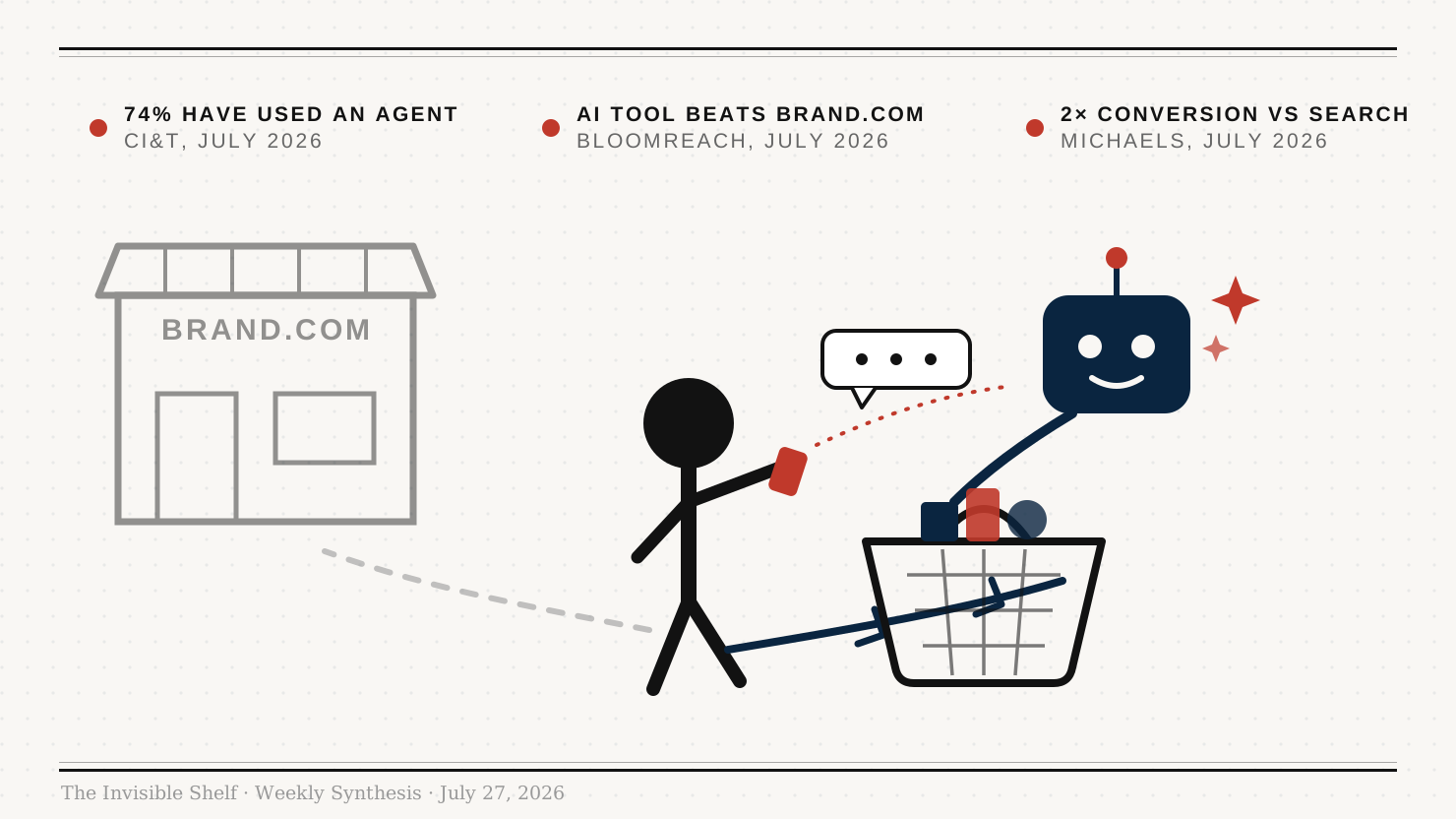
Last week, this publication argued that agentic commerce had stopped being a forecast. This week the market answered with something rarer than momentum: corroboration. Two consumer surveys from unrelated firms, fielded separately, published a day apart, arrived at the same conclusion. A national retailer put conversion numbers behind it. And one of the world's largest CPG companies laid out, in unusual detail, what it's doing about it — and why the rest of the industry has less time than it thinks.
The Preference Flip, Confirmed Twice
Bloomreach's new consumer survey delivered the headline finding: if forced to choose, more consumers would rather shop through an AI tool than directly on a brand's website. More than 75% have used next-gen AI to help them shop in the past six months. The report's title says it plainly — AI shopping has gone "from novelty to necessity." Shoppers aren't experimenting anymore. They're relying on it, and most say the experience meets or beats their expectations.
One vendor survey is a data point. Two independent ones are a pattern. A day later, CI&T's Retail Tech Report — its "Agentic Commerce Edition" — found that 74% of US consumers have already used an AI agent when shopping, and nine in ten have either used one or are open to it. Then it added the detail that should concern every brand manager: the single most popular AI-assisted shopping activity, tied with finding the lowest price, is comparing different brands (55%). And 55% of AI users say the technology makes them shop more, while 78% say it makes them smarter shoppers.
Read those together. The shopper's first move in the AI conversation is the brand-versus-brand comparison — the exact moment where shelf placement, packaging, and end-caps used to do the persuading. That moment now happens inside a model's answer, invisibly, at a scale no field team can audit by hand.
The Proof: Conversation Beats the Search Bar
Skeptics could still ask whether any of this converts. Michaels just answered. The arts-and-crafts retailer formally launched "Ask Mike," its Gemini-powered shopping assistant, on July 21 — and then did something unusual: it published the performance data. Shoppers who engage with Ask Mike convert at more than double the rate of traditional site search, and 27% of interactions end in a product click or an add-to-cart. The assistant has handled roughly 75,000 conversations since a quiet May rollout.
The mechanism matters as much as the multiple. Traditional search forces a shopper to decompose a project into keywords — "floral fabric" — and sift results alone. The assistant takes the whole intent — "help me plan a space-themed party" — and returns a curated basket: core supplies plus finishing touches, bundled in one session. Michaels says assistant users bundle where search users buy single items. That is the agentic pattern in miniature: intent in, basket out. And Michaels built it in six weeks.
The Playbook — and the Warning
Which brings us to the story every CPG leader should sit with. In a session covered by The Drum, Kimberly-Clark's senior director of digital and CX, Jeff Long, described how the maker of Huggies, Kleenex, and Depend went from a near-standing start to category-leading AI visibility across twelve North American brands in under a year. The pitch he made to his own leadership team is worth quoting in full.
"I don't know for a fact that AI and agentic shopping is going to be the meteor that kills 100+ year old companies like Kimberly-Clark. But it could be. It might be. And wouldn't you like to do something about it?"
— Jeff Long, Senior Director of Digital & CX, Kimberly-Clark
What "doing something" looked like is the playbook: a dedicated brand-discovery team with authority to publish in days instead of weeks; a content strategy built on third-party validation — dermatologist approvals, clinical claims, seals — because models reward authority they can defend; and relentless measurement. When the company updated the Kotex Wikipedia page after a launch, LLM citations of Wikipedia rose 44% within 24 hours. The results: Kleenex holds 70% AI visibility in facial tissue. Depend jumped from fifth to second in adult care in 30 days — and is the only top-five brand in its category gaining visibility this year. The other four are losing ground.
The warning attached to the playbook is the reason for urgency. Roughly half of consumers say they'd be comfortable handing household shopping to an agent entirely. Once an agent settles on a brand for a recurring purchase, it builds a preference model, human decisions become less frequent, and the conditions for switching harden with every cycle. Long's framing: the job isn't convincing a happy Pampers household to switch to Huggies. It's being the brand the agent chooses before that preference hardens.
What This Means for CPG Brands, Starting Now
Assemble the week and the sequence is uncomfortable in its clarity. Shoppers have crossed over — twice-confirmed. The conversion math now favors the conversational layer, published by a retailer with no reason to exaggerate. And the first mover in CPG has demonstrated both that AI visibility can be systematically built and that visibility gains are coming at direct cost to slower rivals. Awareness is finite; the shelf is being re-allocated right now.
The defaults being set this year will be the hardest distribution battle of the next five to reverse. Which returns us, as ever, to the only question that matters: when the agent builds the basket, is your brand in it?
The Bottom Line
Preference has flipped. Performance is proven. The playbook is public. What separates the brands that win the agentic shelf from the ones that vanish from it is no longer information — it's speed. The shoppers picked a side this week. The agents are picking theirs now.
Sources: Bloomreach consumer survey, July 22, 2026; Chain Store Age on CI&T's Retail Tech Report: Agentic Commerce Edition, July 23, 2026; Modern Retail on Michaels' Ask Mike, July 24, 2026; The Drum on Kimberly-Clark at ANA Brand Masters, May 21, 2026.